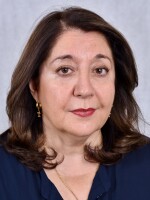
ADRIAN FLORIDO, HOST:
Life is difficult for a lot of people in Lebanon. The ongoing wars, destruction and displacement, a yearslong financial crisis. Girls and women living in refugee camps navigate even more insecurity. NPR's Jane Arraf brings us this story from Beirut on what has been for some the life-changing effect of a Brazilian martial art.
MIRELLA ATALLAH: OK. (Non-English language spoken).
UNIDENTIFIED STUDENTS: (Yelling) Ha.
ATALLAH: Nice. OK.
JANE ARRAF, BYLINE: It's a simple concept - a group of girls and women standing straight and strong and raising their voices.
ATALLAH: (Non-English language spoken).
UNIDENTIFIED STUDENTS: (Yelling) Ha.
ARRAF: But it's taken a lot to get to this point. Trainer Mirella Atallah is teaching residents of this Palestinian refugee camp Brazilian jiujitsu, a form of the Japanese martial art.
ATALLAH: And so watch this.
ARRAF: There are 16 girls in this room, as young as 12, and they've just been doing the...
ATALLAH: (Non-English language spoken).
UNIDENTIFIED STUDENTS: (Yelling) Ha.
ATALLAH: OK.
ARRAF: That sound is the fighting stance.
ATALLAH: (Non-English language spoken). OK.
ARRAF: It's part of lessons on what to do if someone comes after you. But it's not just physical. It's also about increasing their confidence.
The main idea is self-defense, but there's more to it than that.
AISHA SAQQA: (Non-English language spoken).
ARRAF: Aisha Saqqa is 18 and a college freshman. She says two weeks into the class, she feels changed - not just physically, but emotionally stronger. She says Atallah tells them to keep their heads up and notice what's around them, to move their bodies and use their voices - things that girls in this conservative society are often told are unacceptable.
ATALLAH: I had a lady in the program. She actually tried to scream and - to scream for help, and she couldn't. Her voice wouldn't go out.
ARRAF: Atallah, who's Lebanese Canadian, has now taught about 1,500 girls and women in countries including Pakistan and Syria. Her classes, sponsored by aid groups, also include other people on the margins, like foreign domestic workers and the LGBT community. Her students range in age from 12 to 83. We sit in a nearby cafe before the class starts. A server offers hibiscus and mulberry kombucha.
ATALLAH: The situation of girls and women in Lebanon is difficult. It's not us sitting in this cafe. It's not the people you see in downtown. It's only 10% that are able to live the life.
ARRAF: Particularly in the camps, there's grinding poverty and the danger of being attacked in the street or even at home.
ATALLAH: Most of the women I was teaching - they don't go out when it's dark. It's like a cycle. Like, you limit the women from going out. They can't go to the gym. Their health deteriorate. Their mental health is not there.
ARRAF: Atallah herself was raised in a poor family and bullied at school.
ATALLAH: I was never like the other girls. Like, I've never looked like them, never wore clothes like them, so never had the opportunity, like, to buy new stuff and be cute (laughter).
ARRAF: She wanted to learn judo, like her brother, but her parents told her it wasn't for girls. It took her eight years to finish college, often working three jobs at a time. When she graduated, she moved to Kuwait.
ATALLAH: In Kuwait, I had a lot of health problems. My body just shut down. I gained a lot of weight. I hit 125.
ARRAF: Kilos - that's 275 pounds.
ATALLAH: At some point, I had to use crutches, like, to walk. I couldn't move my leg.
ARRAF: Then she moved to Canada, a lifelong dream.
ATALLAH: I went to the gym, started kickboxing and never skipped, even in the heaviest snowstorm. I lost a lot of weight, and I felt so light on my feet.
ARRAF: Six months after she started Brazilian jiujitsu, she entered her first competition and won. Atallah now is 48 and so fit and healthy. She seems at least a decade younger. She has a jiujitsu black belt and is a certified yoga instructor.
ATALLAH: For me, jujitsu - it gave me a voice. I was very shy, and then when I started jiujitsu, I - like, I felt empowered. I felt strong. I felt that I can do anything I want.
(Non-English language spoken).
ARRAF: Back at the makeshift gym at the camp, Atallah asks the girls what they've learned from the course, and what changes they'd like to see.
UNIDENTIFIED STUDENT: (Non-English language spoken).
ARRAF: They mention a girls' soccer field or to be able to ride bicycles. Some mention wanting to see fewer weapons and more trees.
ATALLAH: (Non-English language spoken).
ARRAF: Atallah tells them, "Eventually, things change."
ATALLAH: (Non-English language spoken).
ARRAF: "Let me give you an example," she says. "You know, when you throw a stone in a pool of water and there are ripples? We are the stones." Jane Arraf, NPR News, Beirut. Transcript provided by NPR, Copyright NPR.
NPR transcripts are created on a rush deadline by an NPR contractor. This text may not be in its final form and may be updated or revised in the future. Accuracy and availability may vary. The authoritative record of NPR’s programming is the audio record.