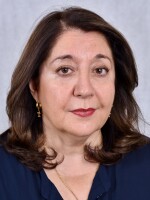
LEILA FADEL, HOST:
Iraq's new prime minister has promised President Trump he will disarm powerful Iran-backed paramilitary groups that are on the Iraqi government payroll, but not under government control.
MICHEL MARTIN, HOST:
Since the U.S. and Israel started the war in Iran, those militias have stepped up attacks on U.S. diplomatic missions and military installations in Iraq.
FADEL: NPR's Jane Arraf joins us from Baghdad to talk about this. Good morning, Jane.
JANE ARRAF, BYLINE: Good morning, Leila.
FADEL: So, Jane, Iraq says it wants to stay out of any war. But with attacks on U.S. targets by these militias and retaliation by the U.S. and, recently, Saudi forces, it seems to have become a battleground. What's going on there?
ARRAF: Well, as you know, Leila, Iran has had a huge influence in Iraq...
FADEL: Yeah.
ARRAF: ...After the 2003 U.S. invasion, right? And that includes both in the government and within security forces. Iran, for instance, backs a coalition that calls itself a resistance of militias, and that's resistance against the U.S. and Israel. And those militias have continued damaging attacks in Baghdad and the Kurdistan region of Iraq against U.S. interests. But the U.S. also has leverage. It's not just the U.S. forces here. They're pulling out by September 30. But since 2003, the U.S. has controlled a lot of Iraq's oil revenue. It holds the revenue, for instance, at the U.S. Federal Reserve, so that's huge leverage. So the new prime minister here, Ali al-Zaidi, met President Trump in June, and he promised Trump that he would disarm these militias. Some of them have agreed, and others have not.
FADEL: Now, you met with one of the militias that says it won't disarm. Tell us about that.
ARRAF: Yeah. This is Kata'ib Sayyid al-Shuhada, one of the main Iran-backed factions. Now, the head of the group is wanted by the U.S. In fact, they offered a $10 million bounty on him three years ago. They've accused him of organizing attacks against U.S. targets in Iraq. So he's understandably keeping a low profile, but we sat down with a group spokesman, Sheikh Kadhim al-Fartousi. And he told us that diplomatic missions are forbidden to them as targets, but as we hear in his answer, he says they believe because of the military and intelligence interests at the U.S. embassy, the diplomatic missions have lost their protected status.
KADHIM AL-FARTOUSI: (Through interpreter) Therefore, the American embassy in Baghdad is not an embassy. The embassy is a very small part and has never been attacked or targeted. What is being targeted is the base located within the embassy compound.
ARRAF: So the U.S. won't comment on damage, but Iraqi security sources and satellite images indicate that a helicopter landing strip and some air defenses were damaged in some of those attacks. And, meanwhile, Leila, this group and others are vowing revenge against Saudi Arabia for recent attacks on bases, while others are advocating diplomacy.
FADEL: Now, U.S. forces are in the process of withdrawing from Iraq, as you mentioned. That's while the war in Iran is still going on. Where does that leave Iraq and particularly the Kurds who run a semi-autonomous region in the north and are a close U.S. ally?
ARRAF: Yeah. The Kurds - it leaves them deeply worried. They have no air defenses of their own, and they host Iranian Kurdish opposition bases that have come under frequent Iranian attack. We asked the prime ministry spokesman, Haider al-Abadi, about the issue, and he says Iraq is hoping to buy U.S. air defenses. But obviously, that's complicated, too. It's not clear what they'd get, and it's not clear how they would deploy them in the Kurdistan region.
FADEL: NPR's Jane Arraf in Baghdad. Thank you, Jane.
ARRAF: Thank you. Transcript provided by NPR, Copyright NPR.
NPR transcripts are created on a rush deadline by an NPR contractor. This text may not be in its final form and may be updated or revised in the future. Accuracy and availability may vary. The authoritative record of NPR’s programming is the audio record.