
Editor's note: This story was produced for the ear and designed to be heard. If you're able, WCMU encourages you to listen to the audio version of this story by clicking the LISTEN button above. This transcript was edited for clarity and length.
David Nicholas: It’s a big election year in Michigan. Voters will select a new governor, U.S. Senator, Attorney General and Secretary of State, just to name a few.
But before election day, local officials must test their voting machines to make sure they’re providing accurate results. This comes as more people are concerned about election security.
WCMU’s AJ Jones went to observe one of these tests and he brings us this report.
AJ: Inside of a small office in Saginaw’s City Hall, city clerk Kristine Bolzman calls a meeting to order.
Kristine Bolzman: Any opposed? The motion is approved.
AJ: It’s a small affair: Bolzman, a few officials, and only two other people are here to witness the test — me and one member of the public. State law requires every jurisdiction must hold a Public Accuracy Test to make sure election tabulation machines count ballots correctly before election day.
Public Accuracy Tests have been law since 1954 in Michigan, but this test comes as more Americans doubt the process.
A recent Gallup study shows 57% of voters are concerned about ballots not being handled properly. Bolzman says transparency measures, like the test, are key to addressing concerns about voting,
KB: The clerks in the area especially, everyone is willing, you know, we will show you, we will answer any questions that you have and show you the process, you know, just the same as we have here.
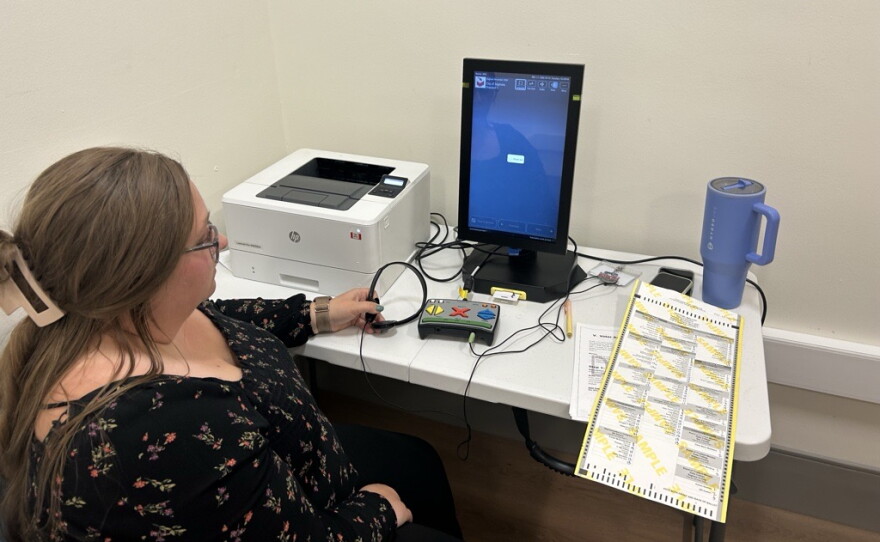
AJ: To start off the test, Deputy City Clerk Breanna Croutch clicks buttons on a control pad at the Voter Assist Terminal or VAT — it helps disabled voters pick candidates.
The VAT displays the ballot on a computer monitor; voters can hook up a pair of headphones to have the ballot read to them.
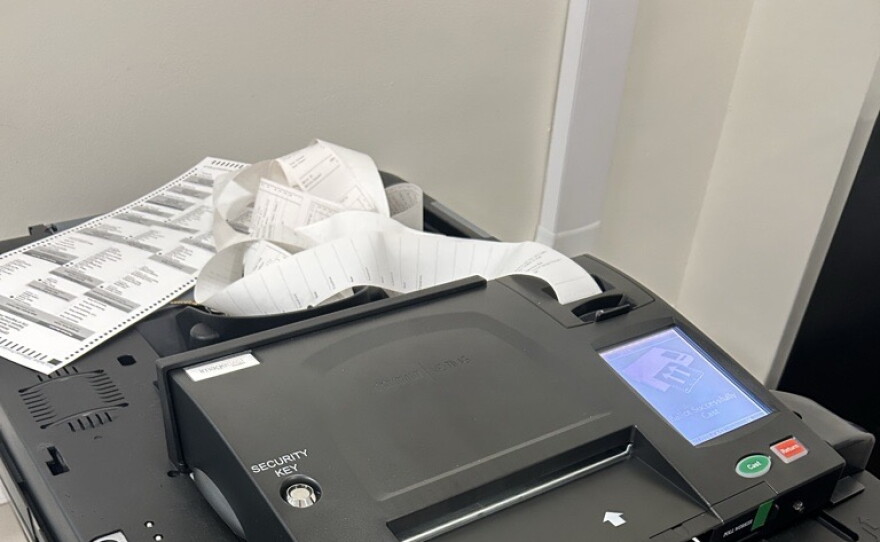
Bolzman continues the test by shifting to a ballot tabulator. Before placing in any ballots, she presses buttons on a touch screen to print the zero-tape.
It’s a long sheet of paper, like a receipt, that has a section for every race on the ballot. The paper has zeros next to every candidate and ballot initiative, signifying that no votes have been counted on the machine yet.
KB: And this is the same process the workers do in the morning prior to the opening polls.
AJ: The zero tape successfully spits out every race that will be on Saginaw’s ballots in November, with a zero next to every race from the top of the tabulator.
Bolzman is now going to test the machines to make sure they can handle every possible ballot error on Election Day.
Common errors include ballots with too many circles filled in one section and ballots where the candidate’s names are circled. She also tests blank ballots, where no circles are filed in.
KB: Blank ballot detected. So, this is where the voter would have the option to either cast anyway, because some people do that, they just want to have the voter history.
AJ: Some people will cast blank ballots, because voter history is public. The ballot does not count for any candidate, but the voter is on record has having voted.
Ballots with errors are spit out by the machine, and the voter can cast a new one. Voters can spoil their absentee ballots after they've sent them in, by request, at their local clerk's office.
Bolzman meticulously files 51 generic ballots into the machine, with their voting selections pre-filled.
The goal of the test is to make sure the results the tabulator spits out, match the pre-determined result.
This makes sure the tabulator is counting the votes correctly.
KB: Yes, I'm certain we want to close the poll. Then, it's going to start printing our results tape.
AJ: A long receipt-like piece of paper with the results on it starts spitting out of the tabulator.
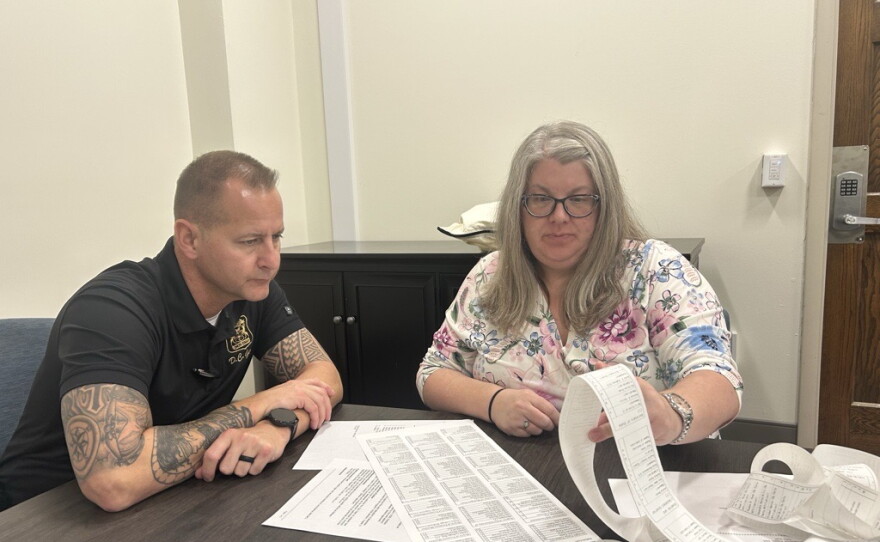
After the test, Bolzman, the city lawyer Amy Lusk, and a local deputy police officer all examine the results and sign off on them.
Lusk reads off the results.
Amy Lusk: So, eight, seven, six, five, four, three, two.
AJ: The votes are tallied up and the results all match. The voting tabulator has passed the test. Bolzman signs off on multiple sheets certifying the test.
KB: Like signing a mortgage.
AJ: The test ballots are sealed in a special bag, where they will remain in the building for 22 months, in accordance with federal law, before being shredded.
This same exact test is being conducted in jurisdictions around the state. Absentee voting is underway, early in-person voting starts on October 24th.
In Saginaw, I’m AJ Jones, WCMU News.


